
As fossil fuelled heatwaves and wildfires kill back home, Spain’s young stars are being used to sell more oil
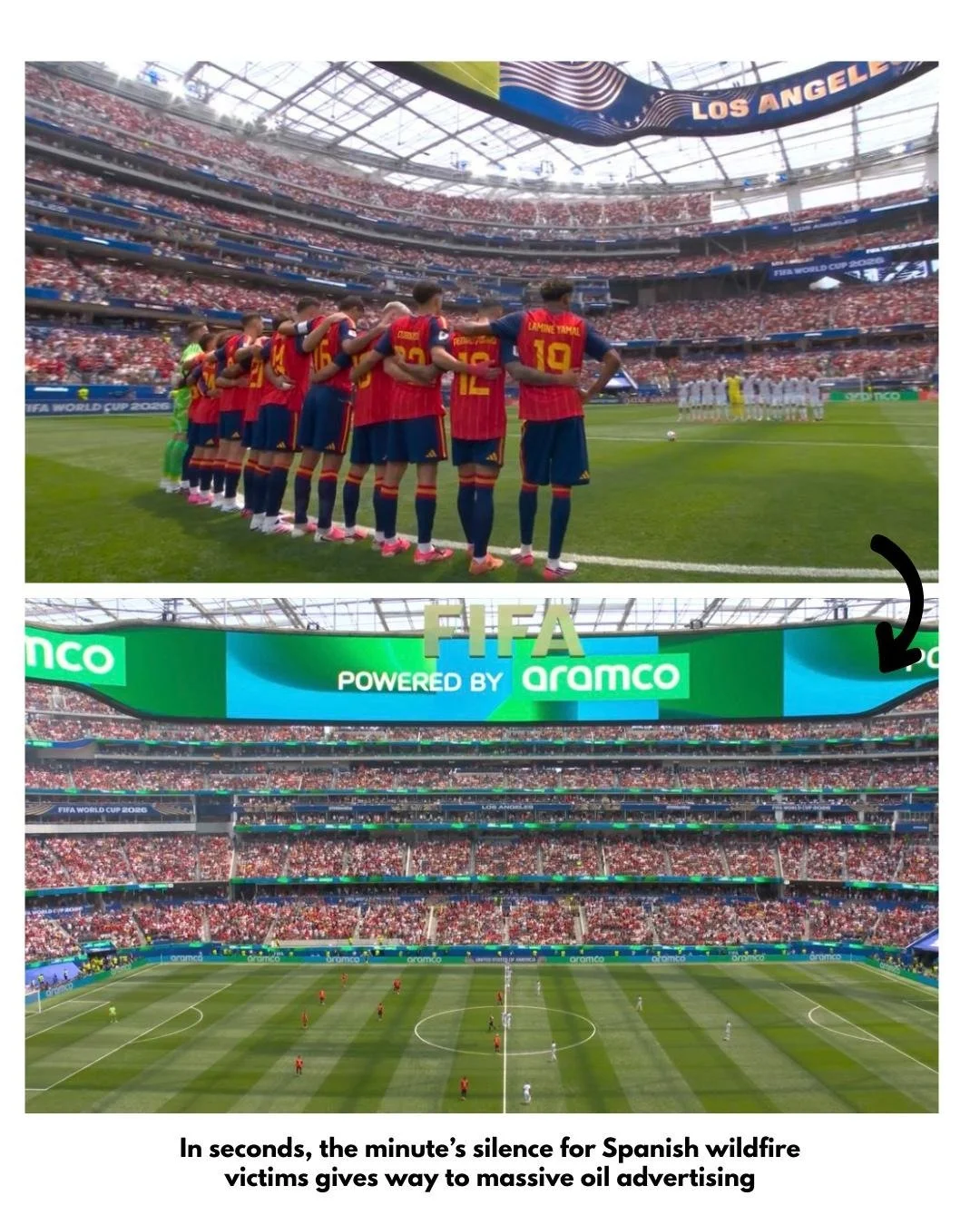
The stadium fell silent in memory of wildfire victims before Spain’s World Cup quarter final. Seconds later, giant screens lit up in the green and blue branding of Aramco, the world’s biggest oil company and FIFA's "major worldwide partner". The commemorations for another climate disaster were over, and football's endless advertising of planet heating fossil fuels was back on.
FIFA have ensured the billions watching the World Cup are served advertising from a company significantly responsible for climate disasters, even as toxic smoke encased New York City and heatwaves across Europe killed thousands.
Concerned that the public might turn away from their toxic product, Big Tobacco once wrapped their branding around children and athletes to make it more appealing. How could cigarettes be a problem if marketed by those radiating vitality and innocence? Today, tobacco companies are banned from pushing harmful products in sport, but Aramco are sponsoring not only the World Cup, but also FIFA’s Young Player of the Tournament Award.

FIFA once claimed to be a sustainability leader, which it should be, not least because extreme summer heat clearly threatens the viability of its main moneymaker, the World Cup. But its choice of sponsor could not have been less appropriate for a tournament in which many games were played in dangerously hot conditions. It felt like 44C when England kicked off against Norway, and “hydration breaks”, “ice jackets” and “wet bulb globe temperatures” have entered the common parlance of fans and pundits.
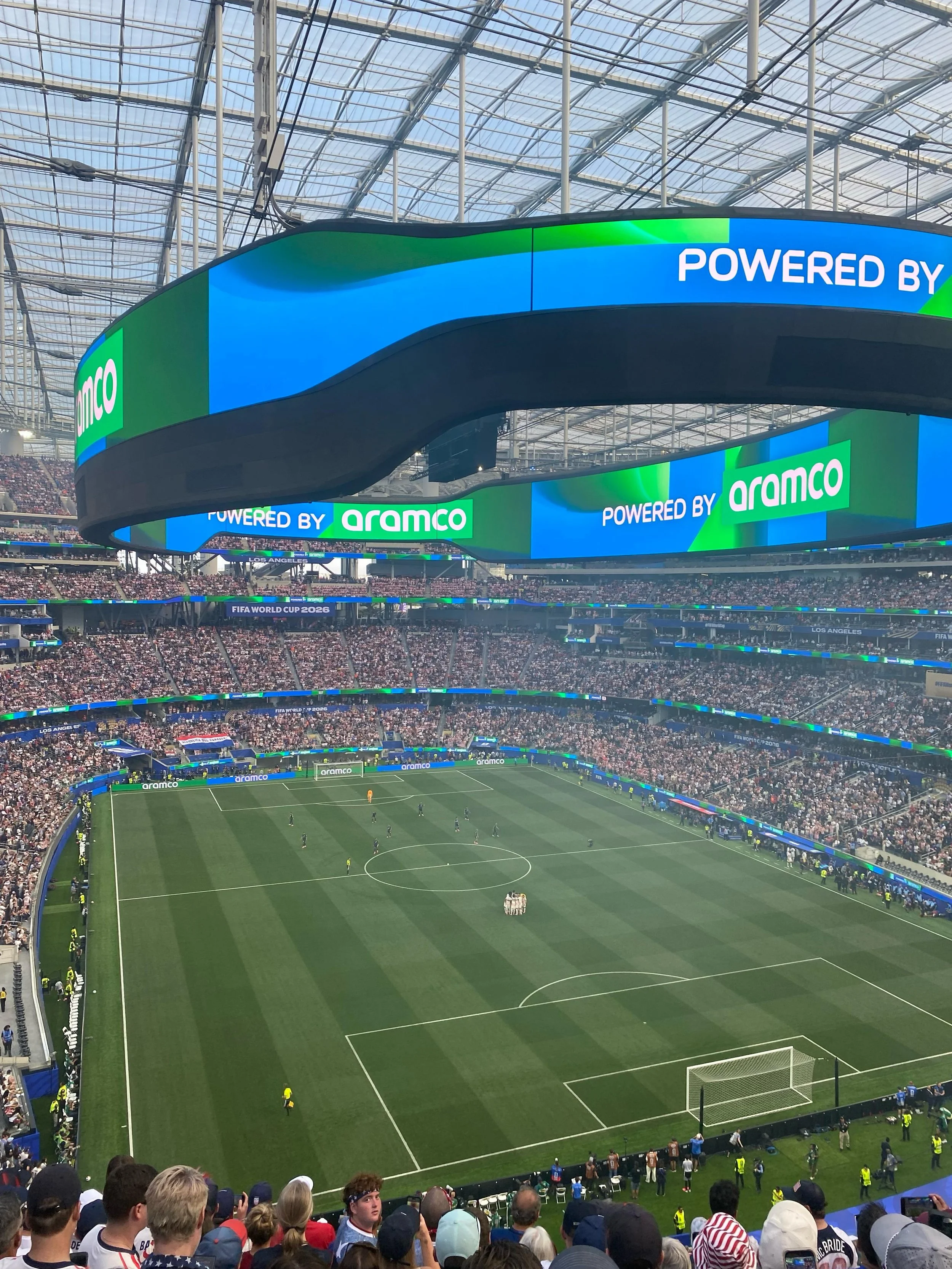
Spain’s Pau Cubarsí eventually won the young player award, which was handed to him post-match by Aramco (and Newcastle United’s) Chair Yasir Al-Rumayyan. The moment was broadcast to millions globally, with the logo prominently featured, as it has been all tournament (alongside the “Powered by Aramco” tagline). But Cubarsi represents a country where over one thousand people died in recent heatwaves, 13 were taken by fire just days ago and 230 were killed in flooding in 2024. His teammate and fellow teenager Lamine Yamal has also been used to push Aramco while being closely tied to climate disasters. His parents are from Larache in Morocco, wherefloods recently forced 50,000 to evacuate and Bata in Equatorial Guinea, which is also dangerously disaster exposed.
But Aramco are likely to be satisfied with their association with these players precisely because they are from Spain, rather than in spite of it. Because the country shows us why big oil are so desperate to bend global audiences to their will. Spain is responding to worsening climate disasters by investing in solar and wind power that make it less tied to the pollution and volatility of oil and gas dependence.
Other award contenders, like France’s Désiré Doué, were representing countries hit with dangerous heat waves and fires. At the same time, coffee and cocoa farmers in Doué father’s (and brother Guéla’s) Côte d'Ivoire are also threatened by drought and flooding. Mexico’s 17 year old Gilberto Mora was also a pre-tournament favourite. He is from a region where hundreds of monkeys dropped from trees in extreme heat in 2024.
Aramco’s reported $100m per year FIFA sponsorship deal shows us that Saudi sport spending is about doubling down on fossil fuels, rather than ‘post-oil diversification’ (as fans are invariably told in football media). It is part of a profit and market maintenance strategy that includes persistent blocking of international climate dealmaking and ‘hooking’ poorer countries on oil.
FIFA bigwig Arsène Wenger is a regular presence at World Cup fixtures. Perhaps Cubarsi or Yamal will inhabit a similar role in the year 2082, when they’ll be the same age Wenger is now. In a far hotter world, will they come to regret the way he was used to sell oil in his youth? The great Johan Cruyff once starred in cigarette ads but then fronted anti-smoking campaigns before he died of lung cancer.
Aside from a tiny elite cocooned in air-conditioned stadiums, footballers can’t play in extreme heat or flooded fields. World Cup games were routinely played in conditions that heat experts and the leading player’s body deem unsafe. The sport is a canary in the climate crisis coalmine but FIFA’s anti-climate decision making is fueling a strange, uncertain future.
Since encouraging fans to take climate action with a “green card for the planet”, Gianni Infantino has massively expanded football’s pollution footprint, adding the Club World Cup and 40 matches to this tournament. He has cosied up to petrostate leaders from Russia to Qatar, to Saudi Arabia and now the US, and jetted around the tournament by private jet.
Extreme heat has already changed the game fundamentally, as FIFA broke with 160 years of convention to split every World Cup match into four quarters. Fans and pundits were quick to point out that the “hydration breaks” seemed motivated more by introducing lucrative mid-game advertising slots than safeguarding players. And, even then, the breaks still failed to conform to the best heat safety advice when temperatures peaked. But much less has been said about FIFA’s commercial partners themselves, who, like Aramco and the oil-dependent aviation and car industries, are the source of the fossil fuel pollution that means cooling breaks are now often genuinely needed.
The warning signs have been clear. FIFA saw an official collapse at a US-hosted Copa America match in 2024, but still failed to institute an appropriate heat safety plan this time. It watched as extreme conditions disrupted the Club World Cup, but still ploughed ahead with the Aramco sponsorship, despite more than 130 professional players calling for it to be dropped. After what has happened in 2026, do FIFA executives seriously still plan for the next edition to take place in midsummer in Portugal, Spain and Morocco (not to forget the three games to be played in Latin America)? And what about 2034, since FIFA handed the tournament to Saudi Arabia? North America will likely have to wait another thirty years before the World Cup returns. But it has surely seen its last summer edition ever.
Supine national football associations must finally stand up on this issue. They’ll have no shortage of potential allies in reforming Infantino’s FIFA, with the spectre of winter World Cups setting up a monumental clash between the global body and the domestic and continental competitions. European parliamentarians recently showed signs that they understand the importance of football governance, calling for investigations into Gianni Infantino’s conduct. Players are also concerned about dangerous heat, while fans recognise the way it slows the game and impacts junior and amateur clubs. Supporters who see the impacts of FIFA’s ‘profit at all costs’ mentality in extortionate ticket prices and water bans could perhaps be engaged on how they’re being sold out on climate too.
Extreme heat clearly threatens the game, from the elite to the grassroots. It is well past time for FIFA to get serious about keeping players and fans safe. It must institute an appropriate heat policy, slash its fossil fuel pollution, return the competition to a less damaging scale, and adopt a tobacco style ban on the advertising of harmful fossil fuels in its competitions.
—
Peter Crisp - Fossil Free Football
Andrew Simms - The New Weather Institute