
“It’s not a football pitch, it’s a desert”

Image: Glen Carrie, Unsplash
As drought and heat harm European football, big clubs and UEFA take £370m to promote fossil fuels…
In 2026, Europeans faced a summer of dangerous extreme weather.Drought fuelled extraordinary wildfires,heat killed at least 35,000 people and low water levels threatened economies and even forced a nuclear power plant to shut down.
The climate threats to amateur and professional football also became clearer than ever. Clubs across Europe were forced to cancel weeks of matches to keep players safe, also leading to further financial and administrative burdens. In 2022, UEFA, the governing body responsible for safeguarding European football, promised to halve its emissions by 2030 and reach net-zero by 2040, as a signatory to the UN Sports for Climate Action Framework. But in 2026 it announced a ‘strategy upgrade’ which removed reference to these targets, without mentioning the UN Framework. Now, despite the harms seen this summer, UEFA’s most important competition, the Champions League, remains saturated with advertising that promotes consumption of fossil fuels and worsens the climate dangers harming the game.
Our new publication explains, that eight of the top ten best clubs in Europe (ranked by UEFA coefficient), have polluter advertising on their shirts. These sponsorship deals are estimated to be worth at least £370m / €430m per year. This excludes UEFA's deal with Qatar Airways, reportedly worth €500m for six years.
Football Harmed by Extreme Weather this Summer
Hot and dry conditions left football pitches and public spaces around the UK hard, cracked and unfit for play this summer. Some leagues, (such as the Anglian Combination) were forced to delay the start of the new season. Tadcaster Albion FC chairman Andy Charlesworth said “it's like playing football on concrete” and these pitch conditions meant players suffered “life-changing” injuries including “smashed elbows” and “fractured skulls”.

Dry playing fields in London. Image: Reddit
Grassroots clubs are often struggling financially, so giving up lucrative early-season fixtures is a major burden, as is hiring or installing artificial pitches. Many routinely miss weeks of football in winter too, exacerbating fixture pile up that could be worse this year if the ‘super El Niño’ produces heavy rain as expected.
In France, Girondins de Bordeaux were forced to move pre-season training away from massive wildfires as 220,000 people evacuated the region. PSG, despite their huge resources, had to move their opening game of the season because their pitch had been damaged by extreme heat. Toulouse had to fork out for an emergency pitch because disease, worsened by heat, also damaged the surface. Lower leagues were also impacted, with one veteran coach saying “I’ve been a coach for more than 30 years, I’ve never seen a football pitch in Laval in this state…it’s not football…it’s a desert”.

The damaged pitch in Laval, France. Image: actu.fr
German lower league associations were also forced to cancel matches, as well as a youth talent development day and various junior tournaments. In Vienna, outdoor events at the Special Olympics, including football, were scrapped, while media in Salzburg reported that a local football pitch “dried up and resembles a dust desert”. In the Netherlands, a club secretary explained that “we’re doing a rain dance every day” while a Swiss club President made clear why cancelled football matters, saying “it hurts to see as a football club now that children, young people…for weeks and months, cannot practice their sport and cannot do what they would like to do”.
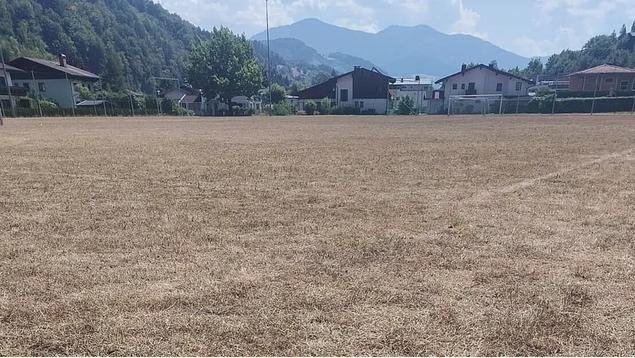
Even close to the Alps, in Austria, this field is heat and drought impacted. Image: Salzburg24
In Hungary, the trade offs of extreme weather adaption became clear as low water levels threatened electricity production at a nuclear plant that supplies almost half the nation’s electricity. The football association moved matches to daylight hours to reduce need for lighting, but Újpest captain Matija Ljujić became unwell, required treatment and was later substituted during a match in temperatures reported at around 40°C.
The Polluter Sponsorship Making Extreme Weather Worse
Of the ten leading European clubs, eight have chosen to promote a corporation that is closely tied to fossil fuels on their shirt. Five are sponsored by petrostate owned airlines.
Bayern Munich, Liverpool and Inter Milan are promoting financial entities that support the fossil fuel industry. Arsenal, Real Madrid, PSG, Manchester City and Atletico Madrid have airline deals while only Barcelona and Borussia Dortmund don’t have polluter sponsorship on their shirt. Pro-fossil fuel sponsorship is also incredibly widespread through the rest of the competition.
UEFA itself has a €500m deal to advertise Qatar Airways which research from Scientists for Global Responsibility and the New Weather Institute found would induce emissions of about 4 million tonnes of carbon dioxide equivalent every year.

UEFA has a €500m deal to promote Qatar Airways. Image: UEFA
Polluter advertising is essentially impossible to miss for football fans, helping to normalise their activity and boost these industries, despite the urgent need to scale them down.
This state of affairs sits in marked contrast with UEFA’s pro-climate and pro-grassroots rhetoric and target setting. President Aleksander Čeferin has said that “football has the potential to dramatically shift mindsets on climate change”, but the reality is that the sport is being used to shift mindsets in the totally wrong direction. UEFA had previously committed to halving emissions by 2030 and reaching net-zero by 2040, but this year announced a ‘strategy upgrade’ that saw it remove references to 2030 and 2040 emissions reductions targets entirely.
Fossil Free Football urges UEFA to get serious about the clear impacts of extreme weather and make a plan to rapidly lead on climate action. It must:
Launch research to understand existing and likely impacts
Reinstate its 2030 and 2040 climate targets
Ban polluter sponsorships
Revise its competitions to reduce the need for air travel
Communicate pro-climate messaging to the public
As big clubs profit from promoting pollution, the smaller clubs on which they rely are suffering. Football is clearly shooting itself in the foot. It’s time for a total change in direction.
-
Peter Crisp is a campaigner at Fossil Free Football, a fan climate campaign. Visit fossilfreefootball.org and follow on Instagram, LinkedIn and others.